North- or south-facing apartment: how much sun will you actually get?
What each direction means for light, heat and glare, why floor level and neighbouring buildings often matter more than orientation, and how to check before you buy.
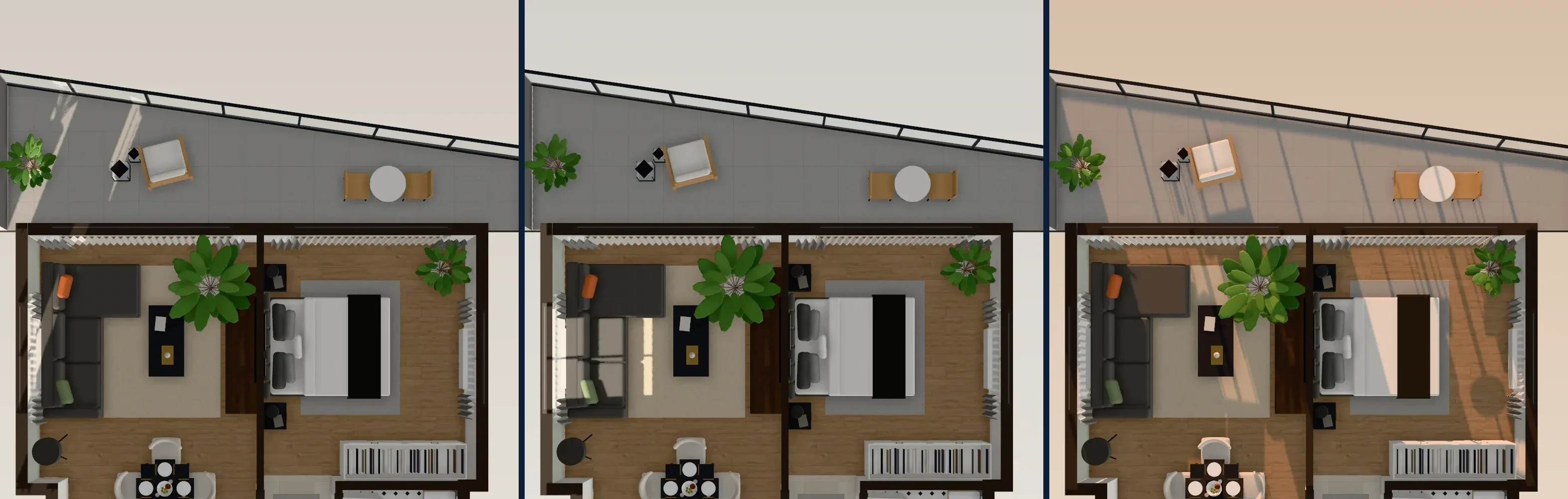
In the northern hemisphere a south-facing apartment gets the most direct sun through the day, east-facing gets mornings, west-facing gets afternoons and evenings, and north-facing gets little direct sun but even light. Floor level and the buildings opposite can matter as much as the direction. “Which way does it face?” is usually the first question about an apartment, and the answer is not as simple as “south is sunny”. This guide explains what each direction gives you, what changes the picture, and how to check a flat, including one that isn’t built yet.
What each direction gives you
In the northern hemisphere:
- South-facing: the most sunlight through the day, and the warmest rooms in winter. The same sun fades furnishings and can overheat a flat in summer.
- East-facing: bright mornings, then no direct sun. Good for a kitchen or a home office; a bright bedroom at dawn.
- West-facing: dim mornings, direct light in the afternoon and evening. Pleasant for evenings, hot in summer afternoons.
- North-facing: little direct sun. Cooler in summer and evenly lit, without glare, but dim in winter.
In the southern hemisphere the sun sits to the north, so north and south swap. Near the equator, for example in Dubai, the sun is high for much of the year, and the difference between directions is less about how much light you get and more about heat and glare: a west-facing living room takes the afternoon sun straight in.
What matters as much as the direction
Floor level. Higher floors clear the shadows of the buildings around them. A third-floor flat can be much brighter than a first-floor one facing the same way.
What stands in front. A tall building close to the south side can leave a south-facing flat in shade. A rule of thumb: if the building opposite is taller than the distance between you and it, you lose a lot of winter sun.
The season. The winter sun is low and the summer sun high. A flat that is bright in June can be shaded from October to February by a neighbour that never touches it in summer.
Window size and balconies. A deep balcony shades the room behind it. A large window on a north wall can still give more light than a small one on a south wall.
Why it matters when you buy
Sunlight is hard to judge at one viewing at one hour, and it is one of the things people notice most after moving in. Some countries treat it as a rule rather than a preference: Polish building regulations require living rooms to get at least three hours of sun on the equinox.
How to check a flat that exists
- Visit at two times, morning and late afternoon, ideally in the season you are least likely to be happy in.
- Use a compass to find which way the main windows face.
- Look at what stands south and west of the building, not only in front of the window.
- Use a shadow map for the neighbourhood, such as Shadowmap, to see how the surrounding buildings shade the street through the year.
How to check one that isn’t built
You can’t visit it, and the neighbouring plots may still be empty. Ask the developer for:
- The orientation of the building and the direction each window faces.
- A sun study for the unit itself, not for the block: hours of direct sun in each room, and at which hours.
- The dates: at least the winter and summer solstices and the equinox.
- The surroundings the study assumed, including neighbouring buildings that are permitted but not yet built.
A sunlight study inside a 3D tour answers this directly: the buyer moves through the flat, changes the date and hour, and sees the sun and shadows for the building’s real location and orientation, with the hours of direct sun for each room.
A short checklist
- Which way do the main windows face?
- Which floor, and what stands across from it?
- How many hours of direct sun in the living room in winter?
- Where does the balcony sit, and does it shade the room behind it?
- Is the flat bright at the hours you are actually home?
If you’re a developer and your buyers ask these questions, InsideWalk builds every unit as a walkable tour with the sun for any date. Start with a free sample unit.